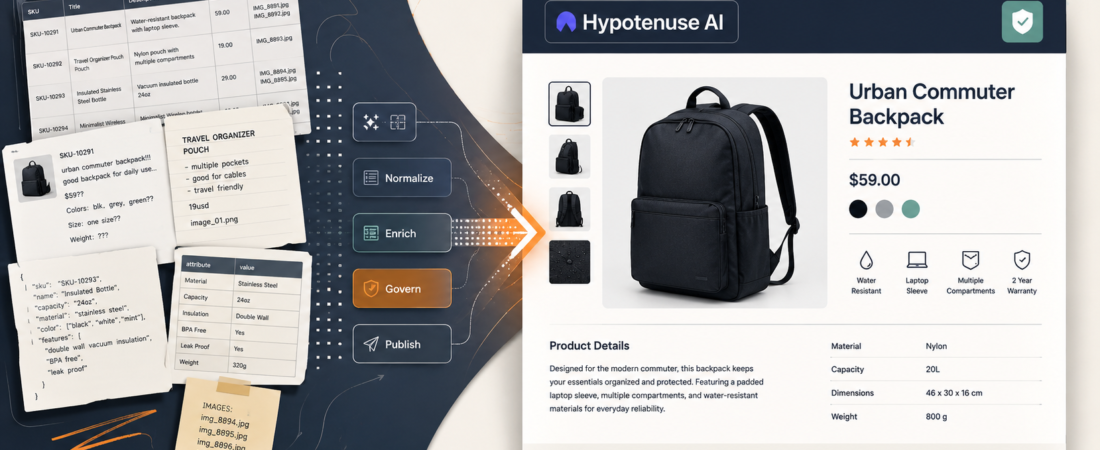
Most AI writing tools begin with a blank box. Hypotenuse AI begins with a catalog problem: incomplete attributes, supplier copy that sounds like every other store, inconsistent taxonomies, and hundreds of product pages waiting for someone to clean them up.
That distinction matters. If I had 25 products and simply needed nicer descriptions, I would not buy a product-data platform. I would use a general writer and keep the catalog in Shopify. If I had 2,500 SKUs arriving from several suppliers, however, the writing is no longer the difficult part. The difficult part is keeping every claim, field and channel consistent.
Fact-check date: August 25, 2026. I checked the current ecommerce plans, feature matrix and data-workflow claims against Hypotenuse AI’s official documentation.
I would test Hypotenuse with 100 ugly SKUs—not one perfect prompt
A polished demo product tells me almost nothing. My useful trial file would contain 100 rows: duplicate color names, mixed measurement units, missing materials, supplier descriptions in different tones, and several fields that should never be guessed. That resembles the work an ecommerce team actually inherits.
Can “navy,” “midnight” and “dark blue” map to a sensible controlled value without erasing a real distinction?
Can the system fill useful gaps from trusted inputs—and show me what still needs evidence?
Can every output obey brand, legal and marketplace rules before anyone presses publish?
This is also where my editorial rule for AI applies: generation is not verification. The same human review I recommend in my one-video-to-ten-posts workflow becomes more important when a sentence can create a product claim. “Water-resistant” and “waterproof” are not stylistic variants; they can have different commercial consequences.
What the platform actually replaces
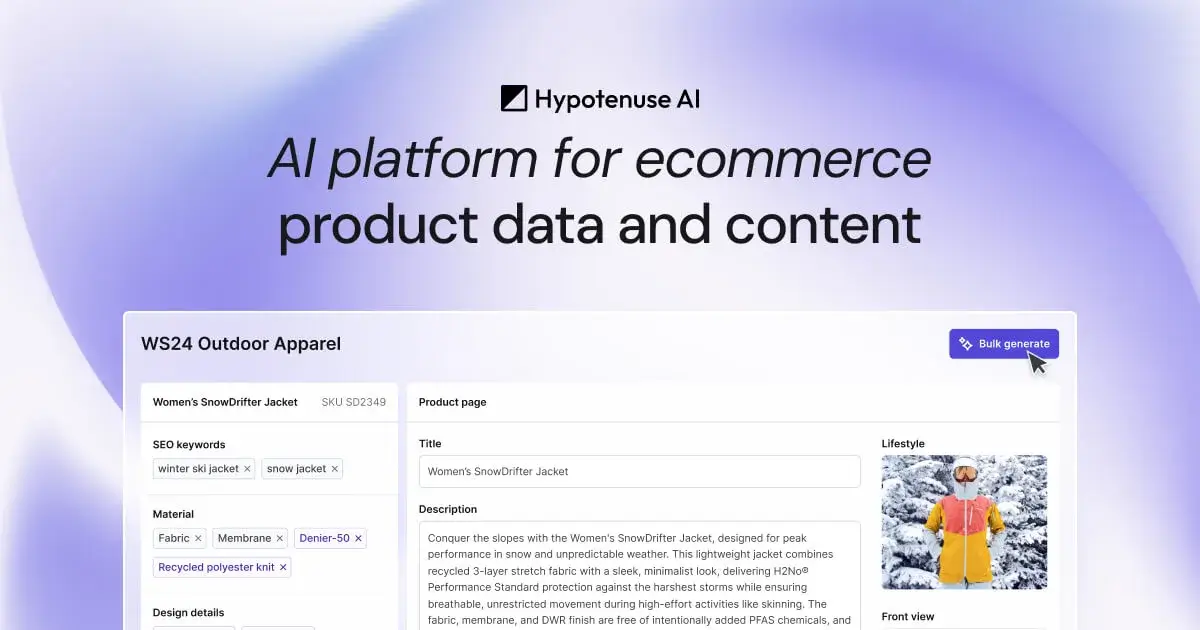
Hypotenuse now positions its ecommerce product as an AI-first product experience management layer. The official feature list covers product descriptions, attribute enrichment, tagging, categorization, taxonomy management, product information management, image editing, guideline checks, SEO monitoring and bulk CSV/XLSX workflows. Enterprise teams can connect PIM, ERP and commerce systems; smaller teams can use Hypotenuse as the place where product information is prepared before distribution.
That is a different purchase from a transcript-to-copy tool such as Castmagic. Castmagic understands a recording and spins out written assets. Hypotenuse understands a catalog and tries to make every product record usable across channels. Both save drafting time, but the source of truth is completely different.
| Catalog job | Where Hypotenuse helps | What I would still own |
|---|---|---|
| Missing attributes | Enrichment from images, pages, UPCs or factsheets | Approve regulated or performance claims |
| Inconsistent taxonomy | Map tags and categories in bulk | Define the commercial taxonomy first |
| Generic supplier copy | Rewrite in a bespoke brand voice | Choose proof, emphasis and positioning |
| Channel formatting | Custom structures for retailers and marketplaces | Spot-check live rendering and truncation |
| Catalog images | Crop, upscale and replace backgrounds in bulk | Protect color accuracy and product truth |
The feature I care about most is the guideline checker
Bulk generation is easy to sell because the before-and-after number looks dramatic. Governance is less glamorous and more valuable. A checker that catches prohibited phrases, missing fields, wrong units and off-brand structures can reduce the review burden that automation creates.
I would build rules in three layers: facts that may never be invented, brand language that should remain consistent, and channel formatting that can change by destination. Then I would sample failures, not just successes. If the tool produces 97 clean records and three risky ones, I need to know whether those three are obvious in the review queue.
Pricing: the absence of a number is part of the decision
Hypotenuse’s current ecommerce pricing is custom. The Basic tier is described for catalogs under 100 products and includes one seat, 40+ languages, the product-description generator and 20+ ecommerce content types. Enterprise adds bespoke models, enrichment, taxonomy, PIM/ERP integrations, access control and guided onboarding. There is a free trial without a credit card.
I dislike hiding the number because it makes quick comparison harder. But a quote-based model is understandable when the real variables are SKU volume, integrations, languages, review steps and seats. I would ask for a quote only after measuring the current monthly cost of catalog cleanup. Otherwise the demo becomes a feature tour without a business case.
For a small creator business, I would first prove the simpler loop: capture a reliable source, clean it, then repurpose it. My podcast repurposing workflow illustrates the same principle on media rather than SKUs, while my AI podcast repurposing comparison shows why I prefer a specialist stack to an oversized platform. Add a system only when handoffs—not imagination—are the bottleneck.
Where Hypotenuse can disappoint
What I like
- Built around structured ecommerce work
- Bulk import, enrichment and output
- Brand and channel governance
- Catalog-image tools in the same workflow
- Can sit beside a PIM or act as a lightweight source of truth
What gives me pause
- No public ecommerce price to budget quickly
- Setup quality depends on clean rules and trusted inputs
- AI enrichment can create false confidence if evidence is weak
- Too much platform for a small catalog
- Generated prose can still become repetitive across similar SKUs
The repetition problem is not unique to ecommerce. In my Castmagic vs Descript comparison, I separate production from repurposing because combining every job in one AI output usually hides where editorial judgment belongs. I would make the same separation here: product data comes first; persuasive copy comes second.
Who should use Hypotenuse AI?
I would shortlist it for: retailers, marketplaces, manufacturers and ecommerce agencies managing hundreds or thousands of SKUs; teams merging supplier data; multilingual catalogs; and brands whose review queues are dominated by attribute and channel inconsistencies.
I would skip it for: a creator selling a handful of digital products, a boutique store with 30 stable items, or anyone who wants a general blog writer. The site’s broader design and branding tools directory is a better starting point when your main need is visual packaging rather than catalog governance.
My final verdict
Hypotenuse AI earns its place when the catalog itself has become content infrastructure. I like that the product is moving beyond “write 500 descriptions” toward “make 500 product records consistent, reviewable and ready for several channels.” That is a more defensible use of AI.
I would not sign after a beautiful demo. I would upload the ugliest representative 100-SKU sample I own, define five non-negotiable rules, and count how many exceptions still require a merchandiser. If Hypotenuse reduces that queue without inventing facts, it is worth a serious procurement conversation. If it only produces smoother paragraphs, a cheaper tool will do. You can compare that decision standard with the other hands-on reviews on Content Tools Lab.
Hypotenuse AI FAQ
Is Hypotenuse AI free?
There is a free trial and no credit card is required. Ecommerce plans themselves use custom pricing.
Is Hypotenuse AI good for product descriptions?
Yes, especially in bulk. Its stronger advantage is the surrounding data work: enrichment, categorization, brand rules, channel formatting and integrations.
Can Hypotenuse AI manage large catalogs?
The company says there is no fixed SKU cap and describes deployments ranging from thousands to millions of SKUs. Capacity is less important than testing your taxonomy, integrations and review workflow.
Is it better than a general AI writer?
For catalog operations, usually. For a few one-off descriptions or blog drafts, a general writer is simpler and likely cheaper.