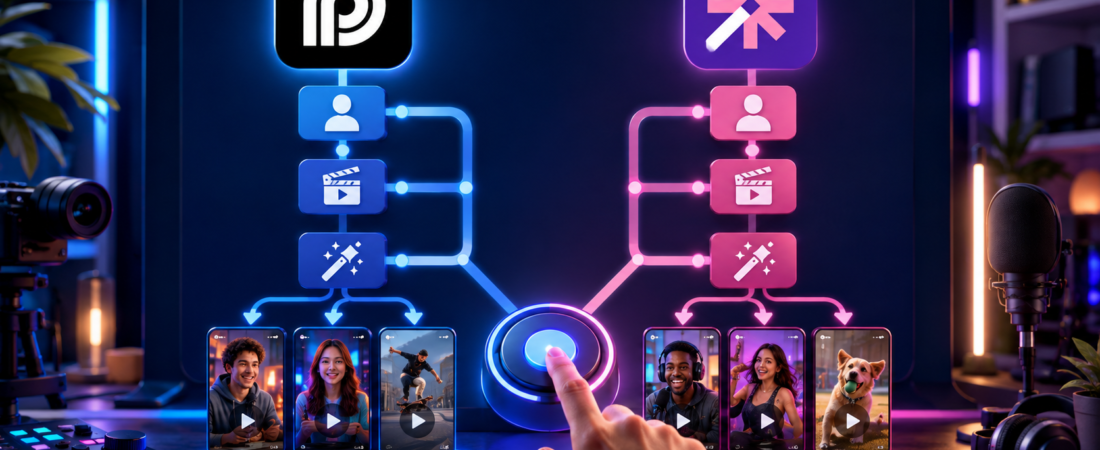
There is no single “best AI podcast repurposing tool.” That phrase hides three different jobs: cleaning the episode, finding short-form moments, and turning a transcript into written content. I have made the mistake of buying an all-in-one platform, then opening three other tabs to finish the work it promised to replace. The better approach is to buy for your actual bottleneck.
For most creators, my shortlist is simple: Castmagic for written assets, Descript for the master edit, OpusClip for fast clip discovery, Vizard for a repeatable social queue, and Riverside for recording plus a convenient first pass. They overlap, but they do not feel interchangeable once you run a real episode through them.
If your podcast is mostly audio, start with Castmagic. If it is a video podcast, clean the master in Descript or Riverside first, then add one clipper—not both—until you know you can publish the candidates. A two-tool workflow is usually cheaper and more controllable than forcing one app to do every job.
Last fact-checked: August 17, 2026. Prices and limits below are snapshots from the vendors’ public pricing pages. Annual-equivalent prices are labeled; check the checkout screen before buying because these plans change.
- Quick picks and current limits
- Choose by bottleneck
- Which one is easiest to learn?
- Castmagic for written content
- Descript for the master episode
- OpusClip for automatic clips
- Vizard for social publishing
- Riverside for recording and repurposing
- The workflow I would actually run
- What I would buy at each stage
- FAQ and final verdict
Best AI podcast repurposing tools at a glance
Here is the practical version of the comparison. “Best at” means the job I would trust the tool with first, not every feature it lists on a landing page.
| Tool | Best first job | Useful current limit or price | Where it falls short | Who I would start with |
|---|---|---|---|---|
| Castmagic | Show notes, blog drafts, newsletters, social copy | Hobby is $19/mo billed annually; the library total is 30 transcribed hours | Not a full timeline editor; the source-hour allowance is the real budget | Audio-first podcasters who publish written content every week |
| Descript | Transcript-based audio and video editing | Free: 1 media hour + 100 AI credits/month. Hobbyist starts at $16/person/month on annual billing | Media hours and AI credits are separate; batch clip discovery is not its strongest workflow | Talking-head creators and hosts who need editorial control |
| OpusClip | Finding and reframing short clips from a long video | Free: 60 credits/month, watermark, no editing, clips exportable for 3 days. Starter starts at $15/month | It can find a complete sentence without finding a genuinely good idea | Creators who need a large candidate batch quickly |
| Vizard | Branded clips and a social publishing queue | Free: 60 credits/month, 720p, 3-day storage. Paid credits are based on uploaded minutes | The paid plan is a moving credit ladder; you need to size it to your upload volume | Social teams that edit and schedule long-form video repeatedly |
| Riverside | Recording, local tracks, and a first set of clips | Free: one-off 2 hours of separate tracks, 720p and watermark. Pro is $24/mo billed annually | It is overkill if your recording setup is already excellent and you only need clips | Remote podcasts where guest experience and recording quality matter |
Choose by the bottleneck, not by the feature list
Before opening a pricing page, finish this sentence: “My episode is already recorded, but I cannot consistently ___.” The blank usually points to the right tool.
Which one is easiest to learn?
There are two kinds of “easy” here. OpusClip and Castmagic are quick to get a first result from because the interface makes the decision for you. Descript takes longer to learn, but the time pays back when you need to make a precise cut. Riverside is easy for a guest to join but has more recording settings for the host. Vizard is straightforward for one-off clips and becomes more involved once you connect accounts, templates, and approvals.
| Tool | First useful result | Learning curve | Where beginners usually get stuck |
|---|---|---|---|
| Castmagic | A transcript-based content package | Low | Accepting the first draft without setting a clear angle or checking facts |
| OpusClip | A batch of vertical clip candidates | Low | Assuming a high virality score means the clip is ready to publish |
| Riverside | A clean remote recording | Low–medium | Forgetting to check separate-track settings, guest permissions, and downloads |
| Descript | A polished transcript and master edit | Medium | Mixing media-hour limits, AI credits, scenes, and the transcript timeline |
| Vizard | A branded clip ready for a social queue | Medium | Underestimating upload-minute credits and the setup needed for accounts and templates |
If you want the lowest learning cost, begin with the tool that produces the asset you already know how to judge. A podcaster who understands show notes will learn Castmagic quickly; a video editor will feel at home in Descript; a social manager will get more from Vizard’s operational features than from another automatic clip score.
1. Castmagic: the best writing layer for a podcast
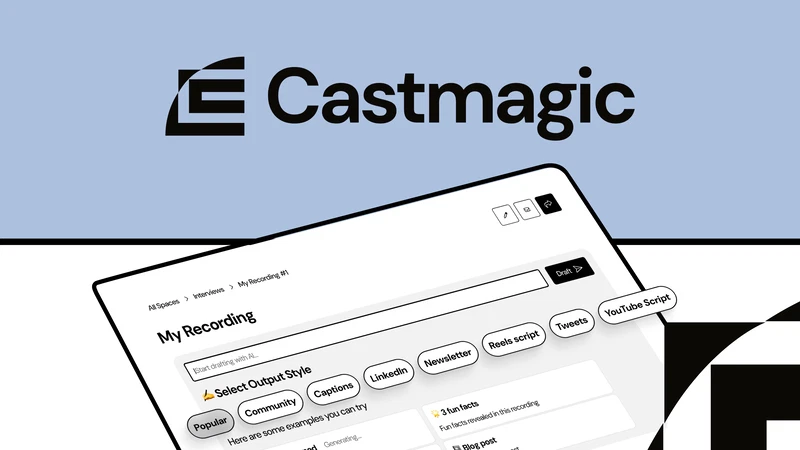
Castmagic is what I would open when the episode is finished but the rest of the content calendar is empty. Upload a recording or connect a supported source, let it transcribe, then use the transcript as the source for show notes, summaries, blog outlines, newsletters, quotes, LinkedIn posts, YouTube descriptions, and custom prompts.
The important distinction is that Castmagic sells a transcription library, not a tiny monthly “AI copy” allowance. Its current public pricing page lists a growing library total of 30 hours on Hobby, 100 hours on Starter, and 400 hours on Team. AI outputs, regenerations, media clipping, and audiogram generation are listed as unlimited. That is a much better model for a podcast archive, but only if you understand what “library total” means.
How I would use it
- Upload the cleaned master, not the noisy first recording.
- Ask for a factual episode brief before asking for promotional copy.
- Generate one long-form draft, one newsletter, and a small set of social posts from the same approved angle.
- Manually add links, product names, and the call to action. “Ready to post” still needs a human pass.
I would choose Hobby for a short weekly show, Starter when I am building a durable archive, and Team only when collaborators, API access, extra spaces, or the 400-hour library justify it. I would not buy Castmagic merely to get a transcript; cheaper transcription tools already do that. Buy it when the repeated written package is the part you keep postponing.
My deeper notes are in the Castmagic review and Castmagic free-plan guide. If you are deciding between writing and editing, the Castmagic vs. Descript comparison is the more useful next read.
2. Descript: the best place to fix what the episode actually says
Descript is my choice when the source episode needs editorial judgment. The transcript becomes the timeline: I can remove a repeated sentence, tighten a rambling answer, correct a name, remove filler words, and improve the sound without scrubbing through a conventional video timeline. Studio Sound, speaker labels, captions, and Create Clips make it a strong master-editing tool.
Its current limits are clear enough to plan around. The free plan includes 1 media hour and 100 AI credits per month. Hobbyist starts at $16 per person/month on annual billing and includes 10 media hours and 400 AI credits; Creator is $24 on annual billing with 30 media hours, 800 credits, and 4K export. Those are different meters. A long episode can consume media hours even when you barely use an AI feature, and a few expensive AI operations can consume credits without adding much source footage.
Descript is also the easiest of these tools to recommend to a YouTube talking-head creator who wants control. Automatic clipping is useful, but the real win is being able to edit the meaning of a sentence as quickly as editing a document. It is not the fastest tool for creating a hundred social candidates, and its writing outputs are not as focused as Castmagic’s.
See my Descript review for the full editor test, and use the podcast editing workflow if you want a repeatable pass from transcript cleanup to export. For a free-plan reality check, the Is Descript free? guide explains what the media-hour and AI-credit limits feel like in practice.
3. OpusClip: the fastest way to create a candidate batch
OpusClip is a clip discovery and reframing tool. Give it a long video, and it looks for moments that might work as Shorts, Reels, or TikToks, then adds captions and a vertical layout. When I need ten candidates from one interview, I would rather reject a few weak clips than hunt manually through an hour of footage.
The free plan is useful for testing but intentionally constrained: 60 credits per month, a watermark, no editing, and a three-day export window. Starter starts at $15 per month and removes the watermark while adding editing and more monthly credits. Pro adds the larger credit pool, team seats, templates, social connections, scheduling, and other workflow features. The exact credit math depends on the job and plan, so I watch the usage meter instead of assuming every final clip costs the same.
OpusClip’s weak spot is not speed; it is context. It can recognize a complete sentence without recognizing that the sentence only makes sense after four minutes of setup. My review pass is strict:
- Does the first two seconds establish a reason to keep watching?
- Can someone understand the clip without the rest of the episode?
- Are the captions accurate for names, numbers, and product terms?
- Does the crop keep the speaker’s eyes and any important screen content visible?
- Would I publish this as a standalone idea, or is it merely an excerpt?
I would use OpusClip after the master edit, not before it. The OpusClip vs. Descript comparison explains the split: OpusClip wins at batch discovery; Descript wins when I need to decide what the episode should say.
4. Vizard: the better fit for a social publishing queue
Vizard feels more operational than OpusClip. It combines AI clip suggestions with an editor, reframing, captions, templates, social connections, and scheduling. That matters when the job is not “find one great clip,” but “process every episode, apply a recognizable brand, and put the approved clips into next week’s queue.”
The free plan currently gives 60 credits per month, 720p exports, one managed social account, and three-day storage. Vizard states that one credit equals one minute of uploaded video on its paid plans, so a 60-minute episode consumes roughly 60 credits before you create your publishing queue. Paid Creator plans add no-watermark 4K exports, scheduling, six social accounts, and storage; Business adds a shared workspace, brand kit, team members, and more accounts. The credit bundle is selectable, which is why I would size it from your actual upload minutes rather than quote a single “Vizard price.”
I would choose Vizard over OpusClip when a second person needs to review, brand, schedule, or publish the clips. I would choose OpusClip when I only want the quickest possible candidate batch and will finish the polish elsewhere. My Vizard AI pricing guide breaks down the credit ladder, while Vizard vs. Descript is useful if you are deciding between a social queue and a full editor.
5. Riverside: the best recording hub in this group
Riverside starts earlier in the workflow. Its value is clean local recording, separate audio and video tracks, a guest-friendly studio, and enough AI editing and repurposing to get from the recording room to a first set of outputs without downloading everything immediately.
The free plan is a real test rather than a permanent production plan: it includes a one-off two hours of separate-track recording, up to 720p video, and a Riverside watermark. The Pro plan is listed at $24 per month when billed annually, with 15 hours of separate-track downloads, up to 4K video, 48 kHz audio, unlimited text-based editing, AI editing and repurposing, Magic Clips, show notes, and podcast hosting. Grow adds scheduling, newsletters, a creator website, and more publishing tools.
I would not subscribe to Riverside solely because it has AI clips. If the recording itself is already clean and your only problem is finding Shorts, OpusClip or Vizard is a more direct purchase. I would choose Riverside when the guest experience, local tracks, recording quality, and publishing handoff belong in the same workspace. Start with my Riverside review and the Descript vs. Riverside comparison if that is your situation.
The workflow I would actually run
For a weekly video podcast, I would not send the raw recording to every tool. I would make one clean master, then branch the outputs. This keeps names, timestamps, and edits consistent and makes it obvious where a mistake entered the process.
Record clean local tracks
Use Riverside when remote guests or separate tracks are the weak link. Capture a backup locally, name the guest correctly, and make a note of any claims that will need fact-checking.
Make one editorial master
Open the recording in Descript (or Riverside’s editor), remove obvious filler, fix names, level the audio, and cut the dead air. This is the version every other tool should receive.
Generate the written package
Send the approved transcript to Castmagic. Ask for a factual brief first, then a blog outline, show notes, newsletter, and social copy that all use the same angle. Add internal links and your real call to action manually.
Create short-form candidates
Use OpusClip when you want speed, or Vizard when you want templates, account connections, and scheduling. Start with a batch, not a promise that every suggested clip is publishable.
Run a human approval pass
Watch every selected clip with sound, read every caption, check names and numbers, and ask whether the hook works for someone who did not hear the episode. Export only after that pass.
What I would buy at three different stages
Solo audio podcast: start with the writing bottleneck
If the show is audio-first and the episodes are around 20 minutes each week, I would start with Castmagic Hobby. That pace is roughly 17 source hours over a year, which leaves room inside its 30-hour library total if I keep the archive tidy. I would use Descript’s free plan or an existing editor for occasional cleanup, then pay for a video clipper only when video becomes part of the distribution plan.
Weekly video podcast: one editor, one clipper, one writing layer
For a 45–60 minute weekly video show, my practical stack would be Riverside Pro for recording, Descript Hobbyist or Creator for the master edit, Castmagic Starter for the written archive, and either OpusClip Starter or a correctly sized Vizard Creator plan for clips. I would not subscribe to both clippers on day one. Run the same episode through each trial, compare the usable clips—not the number of suggestions—and keep the one that saves the most review time.
Small team or agency: pay for collaboration, not just AI buttons
Teams should look at seats, shared spaces, brand controls, API access, storage, and review permissions before another generation feature. Castmagic Team, Descript Creator or Business, Vizard Business, and Riverside Grow or Business can all make sense, but only when multiple people are actually handing work off. If one person still owns every decision, the extra seats are an expensive dashboard.
The mistakes these tools still do not fix
- Buying by feature count. A tool can list captions, blogs, clips, and AI avatars while still being mediocre at the one step you do every week.
- Ignoring the source-meter. Castmagic’s library total, Descript’s media hours, OpusClip’s credits, and Vizard’s upload minutes are different accounting systems. Compare the meter that your workflow will actually consume.
- Publishing the first clip batch. The first batch is research. Remove the clips that need episode context, correct captions, and rewrite hooks that begin too slowly.
- Letting AI invent the angle. Decide what the episode is for—education, trust, lead generation, or entertainment—before generating five versions of the same vague summary.
- Skipping the archive. Keep one approved transcript, one master export, and a simple naming convention. It saves more time than another AI button six months from now.
AI podcast repurposing FAQ
What is the best free AI podcast repurposing tool?
There is no single winner. Descript is the most useful free editor to test transcript-based editing; OpusClip and Vizard are useful for testing short clips; Riverside is useful for testing remote recording. Their free limits are small enough that I would use them to validate a workflow, not run a weekly production system forever. Castmagic offers a trial, but I would buy it for the written time saved rather than expect a large free tier.
Can one tool create all of my podcast content?
Several tools now cover recording, editing, clips, and written outputs, but each still has a strongest job. A two-tool workflow—one source-of-truth editor plus one writing or clipping layer—is usually easier to review and cheaper to keep consistent.
Is Castmagic better than Descript?
They solve different bottlenecks. Castmagic is better when the transcript needs to become show notes, a blog, a newsletter, and social copy. Descript is better when the recording needs editorial cuts, sound cleanup, captions, and a dependable master export. If you need both, use Descript first and Castmagic second.
Should I use OpusClip or Vizard for podcast Shorts?
Use OpusClip when you want the fastest candidate batch and will finish the polish elsewhere. Use Vizard when a team needs templates, social accounts, scheduling, shared workspaces, and a repeatable queue. Test the same 20-minute episode in both and count approved clips, not suggested clips.
Is Riverside enough for repurposing a video podcast?
It can be enough if the recording workflow is your main problem and you are happy with its editing and publishing layer. I would still use a dedicated clipper for high-volume Shorts and a writing tool for a serious blog or newsletter package.
Can I publish AI-generated show notes without reviewing them?
I would not. Check names, numbers, claims, quotes, timestamps, links, and the call to action. AI is excellent at giving you a structured first draft; it is not accountable for accuracy or for your relationship with a guest.
For most independent podcasters, I would start with Castmagic for writing or Descript for editing, depending on which task is being skipped. Add OpusClip for speed or Vizard for a social publishing operation. Choose Riverside when the recording itself deserves to be part of the content system. The “best” tool is the one that removes your slowest step without creating a new review problem.
Sources and fact-check note: I checked the public Castmagic pricing page, Descript pricing page, OpusClip pricing page, Vizard pricing page, and Riverside pricing page on August 17, 2026. Vendor limits and prices can change, so use those links to confirm the final plan before subscribing.