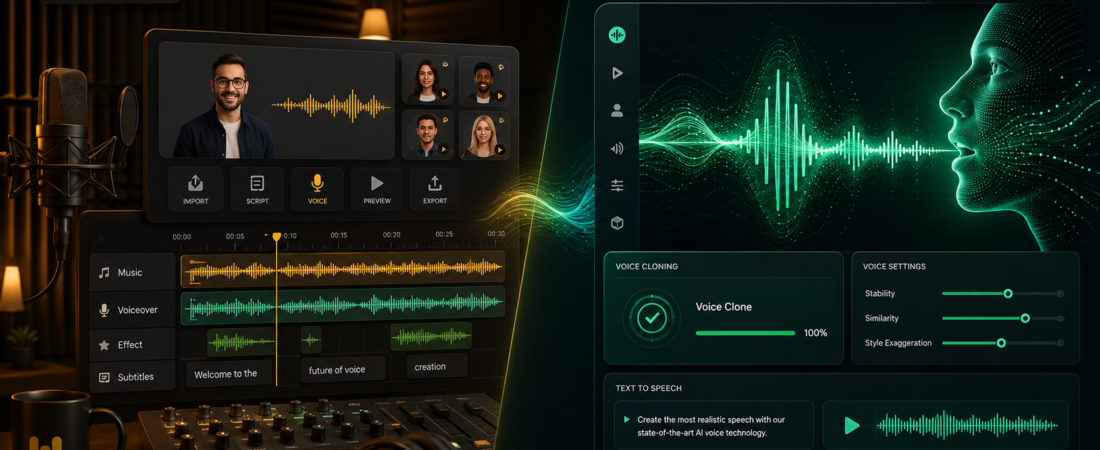
Murf AI and ElevenLabs are often placed in the same “AI voice generator” box, but that label hides the decision that actually matters. ElevenLabs is the tool I reach for when the voice itself has to carry the video. Murf is the one I would choose when the voice is only one part of a repeatable production job.
I tested the choice through four jobs creators really do: narrating a faceless YouTube video, cloning a personal voice, building a training lesson, and handing work between teammates. My short answer is simple: ElevenLabs wins on realism and voice cloning; Murf wins on guided production and presentation-style workflows.
The difference I noticed before comparing features
ElevenLabs opens with the voice. You paste text, choose or create a voice, adjust the delivery, and generate audio. The product encourages experimentation with voices, languages, styles, and models. It feels like a specialist instrument.
Murf opens with the project. Its studio mentality makes more sense when you are matching narration to slides, scenes, or an existing video. Pronunciation rules, timing, music, and visual context feel closer to the centre of the job. That distinction is more important than counting how many voices appear on a pricing page.
If your workflow continues into transcript editing and cleanup, my Descript review shows the opposite end of the spectrum: Descript edits the recorded content itself, while Murf and ElevenLabs create the narration. For podcast-first work, I would also read my practical guide to editing a podcast in Descript before assuming synthetic voice is the missing piece.
Voice quality: ElevenLabs still gives me fewer “AI moments”
The best ElevenLabs voices handle pauses, emphasis, and sentence endings with less of the polished-but-flat cadence that gives synthetic speech away. That difference grows when the script is conversational. A product tutorial can survive a slightly formal delivery; a first-person YouTube essay cannot.
Murf is entirely usable for explainers, training, product demos, and corporate narration. In fact, its predictability can be useful when you want every module to sound consistent. But when I audition both tools for a voice-led story, ElevenLabs more often produces a take I would keep without rewriting punctuation just to force the right performance.
Voice cloning: a clear win for ElevenLabs
ElevenLabs offers Instant Voice Cloning from its Starter plan and Professional Voice Cloning from Creator upward. The higher-grade option requires better source material and more setup, but it is the route I would take if the goal is a stable version of my own voice rather than a quick novelty clone.
Murf has voice-cloning capabilities aimed more heavily at managed and business use. That can suit an organisation creating an approved brand voice, but it is less attractive for a solo creator who wants to experiment today. ElevenLabs also has the stronger ecosystem for speech generation and API-driven voice products.
Cloning deserves a basic ethical rule: only clone a voice you own or have explicit permission to use. A convincing output is not permission. I would also disclose synthetic narration where an audience could reasonably believe a real person recorded it.
Four jobs, four different answers
1. Faceless YouTube narration: ElevenLabs
For a ten-minute documentary or commentary video, voice realism is the product. I would write in short spoken sentences, generate in sections, and keep room for pauses during editing. ElevenLabs gives me the better raw performance, then I can assemble the video elsewhere. If I also needed Shorts from that upload, I would use a separate clipping workflow like the one in my guide to turning a YouTube video into Shorts.
2. Slide-based course or product training: Murf
Here the narration must land on the right slide and remain easy to revise after a stakeholder changes three sentences. Murf’s project workflow is the more comfortable home. Its pronunciation controls are also useful for product names, acronyms, and technical vocabulary that recur across lessons.
3. A cloned creator voice: ElevenLabs
If I wanted to create approved pickups in my own voice, localise a video, or produce a consistent narrator at scale, ElevenLabs would be my starting point. I would still listen to every export; a clone can match timbre and still choose the wrong emotional emphasis.
4. A marketing team with review rounds: Murf
Murf makes more sense when writers, editors, and reviewers need a shared project rather than a folder of generated WAV files. ElevenLabs can support serious production, but Murf’s interface explains the workflow to non-audio specialists more naturally.
Murf AI vs ElevenLabs pricing in 2026
Pricing changes, so I checked the official pages on August 20, 2026. Murf’s annual-billing prices listed Starter at $19 per month with 24 hours of voice generation per year, and Business at $66 per month with 96 hours per year. Its free trial includes 10 minutes of generation, but it is best treated as an audition: download and commercial-use restrictions make it unsuitable as a permanent production plan.
ElevenLabs lists Free at 10,000 credits, Starter at $6 per month, Creator at $22 per month (with a discounted first month shown at the time of checking), Pro at $99, Scale at $299, and Business at $990. Credits are not as intuitive as hours because consumption varies by model and feature.
| Question | Murf AI | ElevenLabs |
|---|---|---|
| Can I test it free? | Yes, 10 generation minutes; limited output rights/downloads | Yes, 10,000 credits |
| Lowest paid entry | $19/month billed annually | $6/month Starter |
| What the allowance resembles | Generation hours per year | Credits consumed by features/models |
| Best value for | Planned narration projects | Creators testing voice generation and cloning |
I would not decide by the headline monthly number alone. Run one real script, note how many regenerations you need, and calculate the cost of a finished minute. A cheaper plan becomes expensive if you burn allowance fixing delivery.
What each tool is worse at
Where Murf frustrates me
The free experience is restrictive, and the best-value comparison is harder because Murf packages time annually while ElevenLabs uses credits. Its voices are good, but I sometimes hear a controlled corporate smoothness where I want a more lived-in performance. Creators focused only on audio may also feel they are paying for workflow features they do not need.
Where ElevenLabs frustrates me
Credits make experimentation feel metered. A strong voice does not remove the need for audio editing, music, timing, or visual assembly. It is easy to generate impressive samples and still lack a dependable end-to-end production system. If your final deliverable is a polished podcast episode, tools focused on recording and post-production—covered in my Riverside review and Descript Studio Sound test—solve a different and often more urgent problem.
Which one should you choose?
- Choose ElevenLabs for faceless YouTube narration, audiobooks, expressive character work, personal voice cloning, multilingual speech, or an API-centred product.
- Choose Murf for e-learning, presentations, internal training, product explainers, pronunciation-heavy scripts, and projects reviewed by a team.
- Choose neither yet if your biggest bottleneck is editing recorded conversations. Start with Descript or Riverside, then add synthetic narration only when the use case is clear.
For a broader content system, voice generation is only one branch. My guide to turning one video into ten social posts shows how I separate clipping from written repurposing, while my comparison of the best AI podcast repurposing tools covers what happens after the recording exists.
Final verdict
I would personally pay for ElevenLabs when the audience is coming for the narrator. It sounds more convincing, offers a clearer path into personal voice cloning, and gives solo creators an inexpensive paid entry. I would pay for Murf when the deliverable is a repeatable production asset—especially training, presentations, or reviewed marketing content—where keeping the whole job organised saves more time than winning the final five percent of vocal realism.