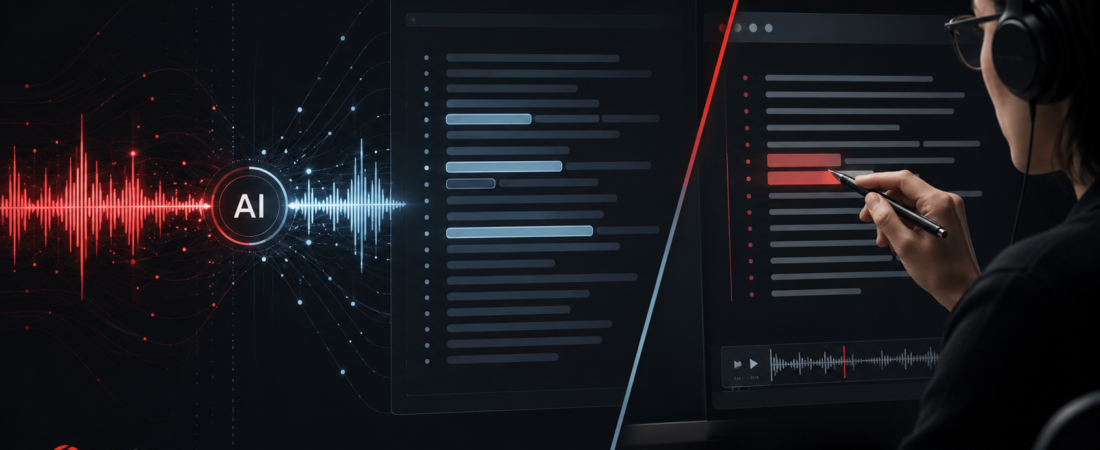
Rev is easy to misunderstand because it sells two very different promises under one name. The AI product promises speed and searchability. The human service promises a transcript you can rely on when a misheard name, number, or qualification would create a real problem.
I do not think the useful question is whether Rev is “accurate.” A quiet solo recording and a remote interview with cross-talk are different jobs. The better question is: what happens if this sentence is wrong? That is the test I used for this Rev review.
Rev is not one transcription product
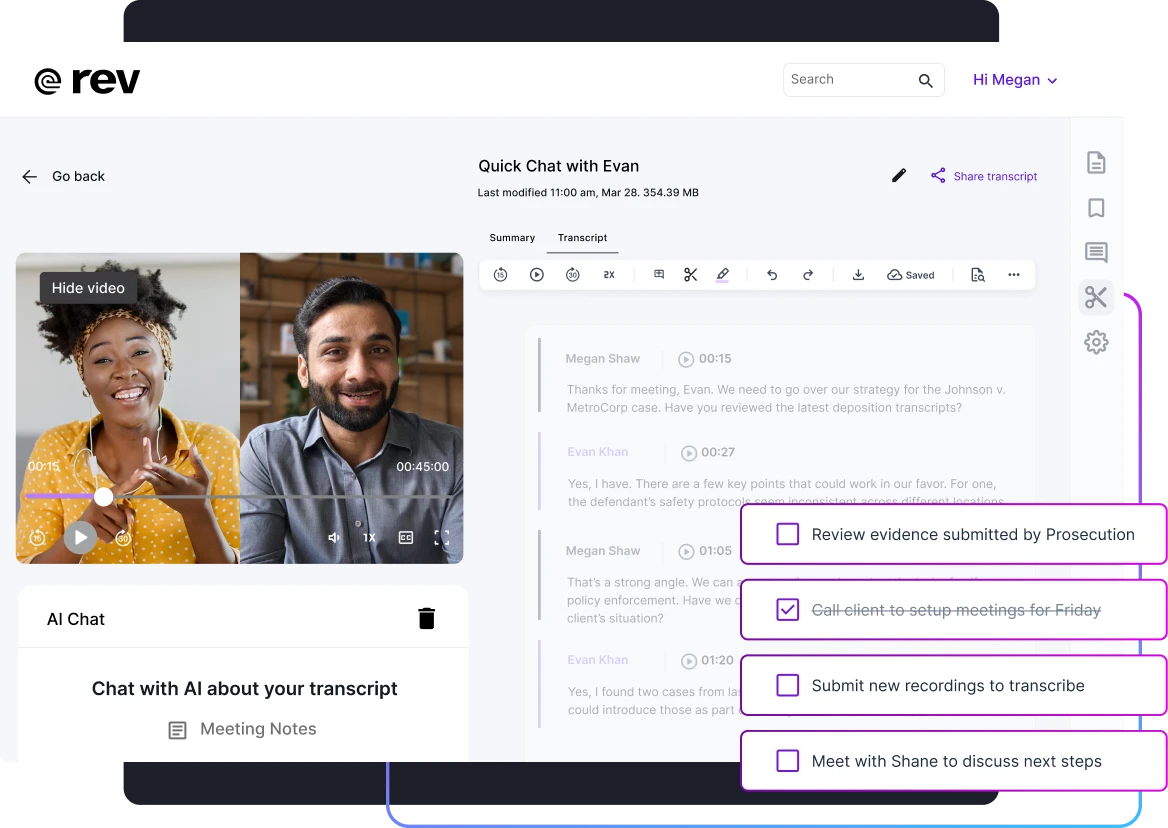
The dashboard, editor, timestamps, speaker labels, and export formats make Rev look like a conventional speech-to-text app. The unusual part is the escalation path. You can start with AI and, when the stakes justify it, order human work rather than moving the file and rebuilding the project elsewhere.
That matters more than a long feature checklist. In a creator workflow, transcription can serve at least four jobs: finding edits, producing captions, extracting ideas, and publishing a readable transcript. Those jobs do not need the same standard.
| Job | What I would use | Why |
|---|---|---|
| Search a podcast for a story | AI transcript | A small word error rarely prevents me from locating the passage. |
| Build a rough edit | AI transcript | Speed matters, and the audio remains the source of truth. |
| Publish social captions | AI, then manual review | Names and short lines are visible enough to check efficiently. |
| Quote an interview subject | Human or line-by-line verification | A confident-looking error can change meaning or attribution. |
| Legal, investigative, or accessibility deliverable | Human service | The cost of an error is higher than the transcription saving. |
If your main goal is editing spoken media rather than receiving a transcript, read my Descript review. Descript turns transcript changes into media edits; Rev keeps the transcript and evidence workflow at the center. They overlap, but they are not interchangeable.
The test I would run: one awkward 30-minute interview
I would not judge Rev on a polished voiceover recorded six inches from a studio microphone. Most modern systems look good on that input. My useful test is a 30-minute remote interview containing a guest name, product names, a few numbers, an interruption, and one section with room noise.
First, run the AI transcript. Correct the recurring proper nouns before doing anything else. Then mark every sentence that will leave the private workspace: the quote for the article, the caption hook, the statistic, and the clip title. Listen to those lines while reading. This is much faster than proofreading every filler word, yet it protects the parts the audience will actually see.
Low consequence
Search notes, rough summaries, internal archives, edit navigation, draft chapters. Here I value speed and findability more than perfect punctuation.
High consequence
Published quotes, medical or legal terminology, compliance captions, evidence, names, prices, and numerical claims. Here I want a human pass or direct verification against audio.
This is also how I approach transcripts inside a broader podcast repurposing workflow: keep one clean source of truth, then let the blog, newsletter, and clips inherit from it. A bad transcript can quietly multiply one mistake across every format.
How accurate is Rev AI?
Rev markets AI transcription as a fast, economical option and human transcription as 99%+ accurate. I would not turn either claim into a universal score for your audio. Accuracy changes with microphones, accents, speaker overlap, connection quality, technical vocabulary, and whether the system has enough context to distinguish a name from an ordinary word.
On creator recordings, the errors that consume time are rarely distributed evenly. A transcript may be excellent for two pages, then stumble on a company name six times. That is why correcting the vocabulary with the highest reuse value comes first. It improves search and makes later editing less irritating.
For comparison, my Descript podcast-editing workflow uses the same principle: correct names and jargon before the main edit. The difference is that deleting ordinary text in Descript can change the media; in Rev, the transcript is primarily the record and navigation layer.
AI is good enough when the audio remains available
When I am using the text to find a moment, outline an episode, or hand a producer a searchable draft, I can always return to the audio. That safety net makes AI errors manageable. It is similar to using Castmagic for written repurposing: the generated structure saves time, but the recording still wins any factual dispute.
Human transcription is not “premium AI”
The human service changes the accountability and review process, not merely the last decimal place of an accuracy score. Rev currently promises 99%+ accuracy and delivery in 12 hours or less for standard human transcription. Rush, timestamps, and verbatim options are available when the job requires them.
Rev pricing: cheap AI, selective human spend
As fact-checked on August 24, 2026, Rev lists AI transcription and AI captions at $0.25 per audio minute on the pay-per-minute option. The Free plan includes up to 45 minutes of AI transcription per month. Human transcription costs $1.99 per minute, and human captions start at the same rate.
| Monthly source audio | AI pay-as-you-go | Human transcription | My recommendation |
|---|---|---|---|
| 30 minutes | $7.50 | $59.70 | AI is the obvious default unless the entire recording is high stakes. |
| 4 × 45-minute episodes | $45.00 | $358.20 | Use AI across the archive; human-review only selected deliverables. |
| 10 hours | $150.00 | $1,194.00 | Compare subscription allowances and build a strict escalation rule. |
The cost gap is exactly why I dislike simplistic “AI versus human” verdicts. A weekly podcaster does not need to spend hundreds of dollars making every “um” perfect. The same podcaster should not paste a disputed quote into a sponsor deck because the AI looked confident.
Is Rev good for podcasts and YouTube creators?
Yes—when you want a durable, searchable transcript and are willing to keep media editing in a separate tool. I would use Rev for interview archives, caption drafts, research calls, and any show where selected lines occasionally need human verification.
I would not choose it as my only podcast production system. A podcast still needs cuts, level control, music, and export. For that, Descript or another editor is a better home. If the recording is already finished and the bottleneck is turning it into show notes and posts, the comparison in Castmagic vs Descript is more relevant.
Rev also does not replace a dedicated clipper. The transcript can reveal a strong sentence, but social video needs a hook, visual framing, caption timing, and a self-contained ending. My AI podcast repurposing tools comparison maps those separate jobs more clearly.
Final verdict: buy certainty only where it matters
Rev earns a place in a professional creator stack because it does not force one accuracy-and-price tradeoff on every file. The AI option is fast enough for everyday editorial work; the human lane exists for moments where “probably right” is not an acceptable standard.
My recommendation is simple. Start on Free or pay by the minute, upload one representative recording, and measure correction time—not just the first impression. If you can repair the few public-facing lines quickly, stay with AI. If names, overlapping speakers, or specialist language turn the transcript into a reconstruction project, escalate that file or the critical section. That is a much more rational use of Rev than picking one lane forever.
Frequently asked questions
Is Rev transcription free?
Rev’s current Free plan includes up to 45 minutes of AI transcription per month. Human transcription is a paid per-minute service.
How much does Rev cost per minute?
Rev lists pay-as-you-go AI transcription at $0.25 per audio minute and human transcription at $1.99 per minute as of August 24, 2026.
Is Rev AI accurate enough for podcasts?
Usually for search, rough editing, notes, and draft captions when you review public-facing names and claims. For quoted or high-stakes material, verify against the audio or use human transcription.
Is Rev better than Descript?
Rev is better when transcript accuracy, searchable archives, and optional human service matter. Descript is better when you want to edit the audio or video through the transcript.
Does Rev provide captions?
Yes. Rev offers both AI captions and human captions. Human captions start at $1.99 per minute and are positioned for accessibility and compliance needs.
Pricing and plan facts checked August 24, 2026 against Rev’s official pricing page and Help Center. Editorial recommendations reflect the workflow described above; prices and limits can change.