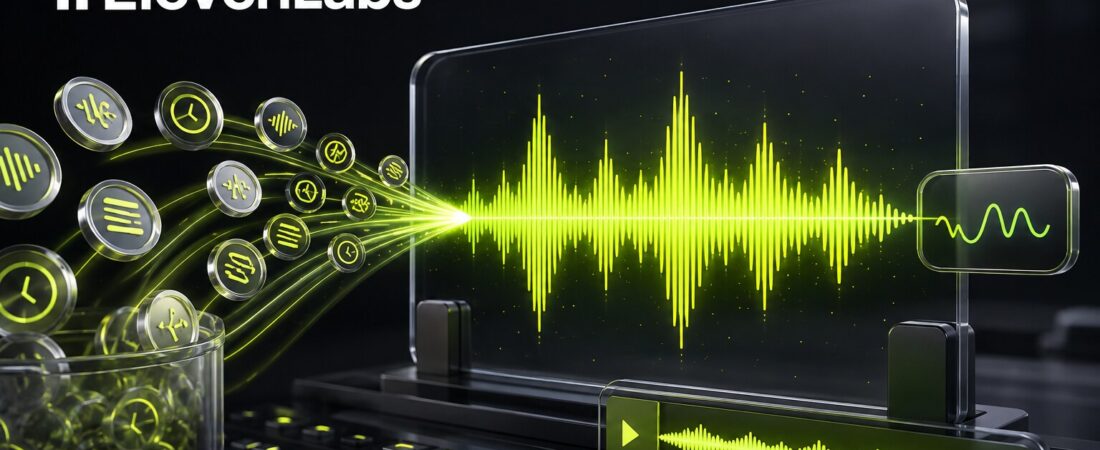
ElevenLabs pricing looks straightforward until you try to answer a practical question such as, “How many ten-minute YouTube voiceovers can I make?” The plans now share one credit pool across text to speech, transcription, music, sound effects, voice changing and dubbing. A credit is therefore not a fixed minute of output. It is a unit that different products spend at very different rates.
My view is that Starter is the commercial-license plan, Creator is the first comfortable solo-creator plan, and Pro is a volume decision rather than a quality decision. Free is excellent for testing voices, but it is the wrong place to build monetized content because it does not include commercial rights.
Estimate the output you make every month, then price the model and product that create it. Do not buy a credit number before translating it into your actual workflow.
ElevenLabs pricing in 2026
| Plan | Monthly price | Included credits | Best fit |
|---|---|---|---|
| Free | $0 | 10,000 | Voice and workflow testing; non-commercial use |
| Starter | $6 | 30,000 | Small commercial projects and instant voice cloning |
| Creator | $22 $11 first month | 121,000 | Regular solo creators and professional voice cloning |
| Pro | $99 | 600,000 | High-volume creator or production work |
| Scale | $299 | 1,800,000 | Publishing teams; 3 workspace seats |
| Business | $990 | 6,000,000 | Organizations; 10 seats and 10 professional voice clones |
| Enterprise | Custom | Custom | Security, support, contract and scale requirements |
These are ElevenCreative subscription prices in USD, checked on August 22, 2026. ElevenLabs also exposes separate pay-as-you-go API pricing, so developers should not assume that the consumer credit table is the cheapest way to serve speech inside a product.
What does one credit actually buy?
For standard Multilingual text-to-speech models, the simple mental model is roughly one credit per text character. Flash and Turbo models can consume less, especially through the API. ElevenLabs’ current pricing FAQ gives these approximate platform costs:
- Text to speech: around 1 credit per character for standard models
- Speech to text: about 330 credits per source minute
- Eleven Music: about 900 credits per generated minute
- Voice Changer and Voice Isolator: about 1,000 credits per minute
- Automatic dubbing: from about 2,000 credits per source minute
- Dubbing Studio: up to about 10,000 credits per minute depending on watermark settings
That spread is why a plan can feel generous for narration and disappear quickly during dubbing. The same 121,000-credit Creator allowance might cover a useful month of YouTube narration but only a small amount of premium Dubbing Studio work.
Real-world usage: three creator scenarios
A weekly eight-minute YouTube narration
At a natural speaking pace, one eight-minute script may contain roughly 7,000 to 8,000 characters including spaces. Four monthly videos can therefore approach or exceed Starter’s 30,000 credits on a standard model, especially after regenerating weak lines. Creator gives a much safer margin. My rule is to budget 20–30% for revisions rather than assuming the first render is final.
Short ads and social clips
If each final voiceover is 20–40 seconds, Starter can be enough. The catch is iteration. Five hooks, three tones and two calls to action turn one short advertisement into thirty renders quickly. This is where a pronunciation library and disciplined script approval save more credits than a larger plan.
Dubbing a 30-minute interview
At 2,000 credits per minute, basic automatic dubbing can consume about 60,000 credits before revisions. Higher-cost Dubbing Studio options use considerably more. A single project can push a Creator user toward Pro or pay-as-you-go. If dubbing is the core product, calculate from source minutes, languages and revision rounds—not the final video count.
Which ElevenLabs plan should you choose?
Free: a serious test with non-commercial limits
Free includes 10,000 credits and lets you judge voice quality, the editor and the product range. It does not include a commercial license. ElevenLabs requires attribution for eligible non-commercial free-plan publishing, while paid-plan output can be used commercially subject to its terms and your rights to the material.
This distinction matters for YouTube. “My channel is not monetized yet” is not a durable production policy. If the goal is a commercial channel, client work, a paid course or an advertisement, generate the final audio while an eligible paid subscription is active. Our ElevenLabs review covers the voice quality and workflow questions that should be settled before paying. If you are comparing free creator plans more broadly, Descript Free has a different kind of ceiling: media hours, AI credits and export resolution rather than a voice-generation allowance.
Starter: the license upgrade
Starter costs $6 and triples the allowance to 30,000 credits. More importantly, it adds commercial licensing and instant voice cloning. I like it for occasional short voiceovers, podcast intros, product demos and creators proving that an AI voice belongs in their format. For podcasters, I would still map the whole episode workflow before buying another specialist subscription; our podcast repurposing tools comparison separates voice generation from editing, clipping and written-content work.
I would not choose Starter for a weekly eight-to-ten-minute narrated channel unless I was committed to a discounted model and very few regenerations. A plan that works only when every draft is perfect is undersized.
Creator: the sensible solo-creator plan
Creator costs $22, includes 121,000 credits and adds professional voice cloning. It is my default recommendation for a regular YouTube or course creator because it creates breathing room between the planned script and the messy reality of revisions.
Pro: volume, not automatically better storytelling
Pro raises the allowance to 600,000 credits for $99. That is attractive for agencies, daily channels, audiobook production or multilingual work. It does not remove the editorial work: scripts still need direction, names still need pronunciation checks and long narration still benefits from human pacing decisions.
Upgrade when the Usage page shows a repeatable deficit. Do not upgrade because a large credit number makes the workflow feel more professional.
Scale, Business and Enterprise
These plans are about seats, concurrency, workspace controls, professional voice clones and predictable volume. A solo creator should rarely jump to Scale purely for credits. If a small team is considering it, compare the added seats and operating controls with the cost of separate individual subscriptions.
Credit rollover helps, but it is not a savings account
Paid subscription credits can roll over up to twice the normal monthly quota while you remain on the same eligible plan. That means your balance can reach roughly three times the plan’s usual allocation: the current month plus up to two months carried forward. Free credits do not roll over.
ElevenCreative subscription or ElevenAPI pay as you go?
Creators working inside the ElevenLabs web application will usually find the subscription easier. Developers embedding speech in an app should price the API directly. ElevenAPI currently lists text to speech at $0.10 per 1,000 characters for v2/v3 models and $0.05 for Flash/Turbo, with other products metered by minutes or generations.
The mistake is mixing the two tables. A Creator subscription is a bundle with product access and a monthly credit pool. API pay-as-you-go is usage pricing. Build a spreadsheet from your expected requests, characters and models before assuming the monthly plan wins.
Where the hidden cost really appears
The obvious cost is the plan. The less obvious cost is generation waste:
- Regenerating an entire paragraph to fix one name
- Testing too many voices after production begins
- Using an expensive model for drafts
- Dubbing before the source edit is locked
- Spending the shared pool on music or effects without noticing
I approve the script first, maintain a pronunciation list, generate in short blocks and lock the source video before dubbing. That workflow matters more than squeezing a theoretical extra minute from a plan. It is also why I compare billing meters rather than headline plan names: Descript pricing, for example, splits media hours from AI credits, while ElevenLabs uses one shared balance across products.
If you are deciding between ElevenLabs and a more structured business voiceover editor, read Murf AI vs ElevenLabs. For cleaning a real speaker rather than generating a synthetic one, Descript Studio Sound solves a different problem. And if the voiceover sits inside a talking-head edit, our Descript review explains when a transcript editor is more valuable than another voice model.
My pick for most creators
Start on Free, generate a representative sample, then move to Creator if you publish weekly or need professional cloning. Use Starter only when the output is genuinely short and occasional.
My pick for developers
Model the API first. Compare character volume, latency model, retries and non-TTS products. A subscription credit bundle is not automatically the right unit economics.
Frequently asked questions
How much does ElevenLabs cost?
Current monthly plans run from Free at $0 to Starter at $6, Creator at $22, Pro at $99, Scale at $299 and Business at $990. Enterprise pricing is custom.
How many minutes are 10,000 credits?
It depends on the product and model. For standard text to speech, 10,000 credits is roughly ten minutes of typical narration; discounted Flash or Turbo usage can stretch further. Dubbing, music and other products spend credits differently.
Can I use ElevenLabs Free for YouTube?
You can publish eligible free-plan output non-commercially with the required attribution, but the Free plan does not include a commercial license. Use a paid plan for monetized or otherwise commercial production and check the current terms.
Do ElevenLabs credits roll over?
Eligible paid subscription credits can roll over for up to two months while you remain on the same plan. Free credits do not roll over, and unused subscription credits are lost when a cancellation or downgrade takes effect.
Is Creator worth it over Starter?
For weekly narration, usually yes. Creator provides substantially more revision headroom and professional voice cloning. Starter is better suited to short, occasional commercial projects.
Fact-checked August 22, 2026 against ElevenLabs’ official pricing, billing, rollover, commercial-use and API documentation. Prices, models and credit rates can change.
ElevenLabs pricing looks straightforward until you try to answer a practical question such as, “How many ten-minute YouTube voiceovers can I make?” The plans now share one credit pool across text to speech, transcription, music, sound effects, voice changing and dubbing. A credit is therefore not a fixed minute of output. It is a unit that different products spend at very different rates.
My view is that Starter is the commercial-license plan, Creator is the first comfortable solo-creator plan, and Pro is a volume decision rather than a quality decision. Free is excellent for testing voices, but it is the wrong place to build monetized content because it does not include commercial rights.
Estimate the output you make every month, then price the model and product that create it. Do not buy a credit number before translating it into your actual workflow.
ElevenLabs pricing in 2026
| Plan | Monthly price | Included credits | Best fit |
|---|---|---|---|
| Free | $0 | 10,000 | Voice and workflow testing; non-commercial use |
| Starter | $6 | 30,000 | Small commercial projects and instant voice cloning |
| Creator | $22 $11 first month | 121,000 | Regular solo creators and professional voice cloning |
| Pro | $99 | 600,000 | High-volume creator or production work |
| Scale | $299 | 1,800,000 | Publishing teams; 3 workspace seats |
| Business | $990 | 6,000,000 | Organizations; 10 seats and 10 professional voice clones |
| Enterprise | Custom | Custom | Security, support, contract and scale requirements |
These are ElevenCreative subscription prices in USD, checked on August 22, 2026. ElevenLabs also exposes separate pay-as-you-go API pricing, so developers should not assume that the consumer credit table is the cheapest way to serve speech inside a product.
What does one credit actually buy?
For standard Multilingual text-to-speech models, the simple mental model is roughly one credit per text character. Flash and Turbo models can consume less, especially through the API. ElevenLabs’ current pricing FAQ gives these approximate platform costs:
- Text to speech: around 1 credit per character for standard models
- Speech to text: about 330 credits per source minute
- Eleven Music: about 900 credits per generated minute
- Voice Changer and Voice Isolator: about 1,000 credits per minute
- Automatic dubbing: from about 2,000 credits per source minute
- Dubbing Studio: up to about 10,000 credits per minute depending on watermark settings
That spread is why a plan can feel generous for narration and disappear quickly during dubbing. The same 121,000-credit Creator allowance might cover a useful month of YouTube narration but only a small amount of premium Dubbing Studio work.
Real-world usage: three creator scenarios
A weekly eight-minute YouTube narration
At a natural speaking pace, one eight-minute script may contain roughly 7,000 to 8,000 characters including spaces. Four monthly videos can therefore approach or exceed Starter’s 30,000 credits on a standard model, especially after regenerating weak lines. Creator gives a much safer margin. My rule is to budget 20–30% for revisions rather than assuming the first render is final.
Short ads and social clips
If each final voiceover is 20–40 seconds, Starter can be enough. The catch is iteration. Five hooks, three tones and two calls to action turn one short advertisement into thirty renders quickly. This is where a pronunciation library and disciplined script approval save more credits than a larger plan.
Dubbing a 30-minute interview
At 2,000 credits per minute, basic automatic dubbing can consume about 60,000 credits before revisions. Higher-cost Dubbing Studio options use considerably more. A single project can push a Creator user toward Pro or pay-as-you-go. If dubbing is the core product, calculate from source minutes, languages and revision rounds—not the final video count.
Which ElevenLabs plan should you choose?
Free: a serious test with non-commercial limits
Free includes 10,000 credits and lets you judge voice quality, the editor and the product range. It does not include a commercial license. ElevenLabs requires attribution for eligible non-commercial free-plan publishing, while paid-plan output can be used commercially subject to its terms and your rights to the material.
This distinction matters for YouTube. “My channel is not monetized yet” is not a durable production policy. If the goal is a commercial channel, client work, a paid course or an advertisement, generate the final audio while an eligible paid subscription is active. Our ElevenLabs review covers the voice quality and workflow questions that should be settled before paying.
Starter: the license upgrade
Starter costs $6 and triples the allowance to 30,000 credits. More importantly, it adds commercial licensing and instant voice cloning. I like it for occasional short voiceovers, podcast intros, product demos and creators proving that an AI voice belongs in their format.
I would not choose Starter for a weekly eight-to-ten-minute narrated channel unless I was committed to a discounted model and very few regenerations. A plan that works only when every draft is perfect is undersized.
Creator: the sensible solo-creator plan
Creator costs $22, includes 121,000 credits and adds professional voice cloning. It is my default recommendation for a regular YouTube or course creator because it creates breathing room between the planned script and the messy reality of revisions.
Pro: volume, not automatically better storytelling
Pro raises the allowance to 600,000 credits for $99. That is attractive for agencies, daily channels, audiobook production or multilingual work. It does not remove the editorial work: scripts still need direction, names still need pronunciation checks and long narration still benefits from human pacing decisions.
Upgrade when the Usage page shows a repeatable deficit. Do not upgrade because a large credit number makes the workflow feel more professional.
Scale, Business and Enterprise
These plans are about seats, concurrency, workspace controls, professional voice clones and predictable volume. A solo creator should rarely jump to Scale purely for credits. If a small team is considering it, compare the added seats and operating controls with the cost of separate individual subscriptions.
Credit rollover helps, but it is not a savings account
Paid subscription credits can roll over up to twice the normal monthly quota while you remain on the same eligible plan. That means your balance can reach roughly three times the plan’s usual allocation: the current month plus up to two months carried forward. Free credits do not roll over.
ElevenCreative subscription or ElevenAPI pay as you go?
Creators working inside the ElevenLabs web application will usually find the subscription easier. Developers embedding speech in an app should price the API directly. ElevenAPI currently lists text to speech at $0.10 per 1,000 characters for v2/v3 models and $0.05 for Flash/Turbo, with other products metered by minutes or generations.
The mistake is mixing the two tables. A Creator subscription is a bundle with product access and a monthly credit pool. API pay-as-you-go is usage pricing. Build a spreadsheet from your expected requests, characters and models before assuming the monthly plan wins.
Where the hidden cost really appears
The obvious cost is the plan. The less obvious cost is generation waste:
- Regenerating an entire paragraph to fix one name
- Testing too many voices after production begins
- Using an expensive model for drafts
- Dubbing before the source edit is locked
- Spending the shared pool on music or effects without noticing
I approve the script first, maintain a pronunciation list, generate in short blocks and lock the source video before dubbing. That workflow matters more than squeezing a theoretical extra minute from a plan.
If you are deciding between ElevenLabs and a more structured business voiceover editor, read Murf AI vs ElevenLabs. For cleaning a real speaker rather than generating a synthetic one, Descript Studio Sound solves a different problem. And if the voiceover sits inside a talking-head edit, our Descript review explains when a transcript editor is more valuable than another voice model.
My pick for most creators
Start on Free, generate a representative sample, then move to Creator if you publish weekly or need professional cloning. Use Starter only when the output is genuinely short and occasional.
My pick for developers
Model the API first. Compare character volume, latency model, retries and non-TTS products. A subscription credit bundle is not automatically the right unit economics.
Frequently asked questions
How much does ElevenLabs cost?
Current monthly plans run from Free at $0 to Starter at $6, Creator at $22, Pro at $99, Scale at $299 and Business at $990. Enterprise pricing is custom.
How many minutes are 10,000 credits?
It depends on the product and model. For standard text to speech, 10,000 credits is roughly ten minutes of typical narration; discounted Flash or Turbo usage can stretch further. Dubbing, music and other products spend credits differently.
Can I use ElevenLabs Free for YouTube?
You can publish eligible free-plan output non-commercially with the required attribution, but the Free plan does not include a commercial license. Use a paid plan for monetized or otherwise commercial production and check the current terms.
Do ElevenLabs credits roll over?
Eligible paid subscription credits can roll over for up to two months while you remain on the same plan. Free credits do not roll over, and unused subscription credits are lost when a cancellation or downgrade takes effect.
Is Creator worth it over Starter?
For weekly narration, usually yes. Creator provides substantially more revision headroom and professional voice cloning. Starter is better suited to short, occasional commercial projects.
Fact-checked August 22, 2026 against ElevenLabs’ official pricing, billing, rollover, commercial-use and API documentation. Prices, models and credit rates can change.