ElevenLabs is the first AI voice tool I reach for when a script needs to sound performed rather than merely read. That is also why I would not recommend paying for it blindly: the best output is excellent, but pronunciation fixes, alternate takes, and experiments can consume credits faster than the tidy plan table suggests.
I tested ElevenLabs as a creator would actually use it—turning finished scripts into YouTube narration, trying a cloned voice, correcting names, and checking what I could publish commercially. My conclusion is fairly simple: ElevenLabs is worth it when voice quality is part of the product. If you only need a disposable voice for an occasional short, its strengths may be expensive overkill.
What ElevenLabs gets right
The difference is not that ElevenLabs can turn text into speech—dozens of tools can do that. The difference is how often the first result already has usable rhythm. Pauses feel intentional, emphasis is less mechanical, and many voices can carry a paragraph without dropping into the familiar “AI announcer” cadence.
That matters most for long-form listening. Viewers will forgive a modest camera; they leave when narration feels exhausting. For a faceless YouTube essay, training module, product walkthrough, or story-led video, a believable voice can do more for perceived quality than another hour of motion graphics.
It also fits neatly into a broader creator stack. I can generate narration in ElevenLabs, assemble the talking-head or screen-recorded edit in Descript, then use a specialist such as OpusClip to find social cuts. Before adding another subscription, I would map the full output with the one-video-to-ten-posts workflow.
The voice library is broad, but selection still takes work
The library gives you many languages, accents, ages, and delivery styles. That choice is useful, yet it creates its own job. A voice that sounds impressive in a ten-second preview can become too theatrical over eight minutes. My method is to audition the same 120-word passage in three voices, including a sentence with a proper noun, a number, and an emotional turn. The winner is the voice that remains easy to listen to—not the one with the flashiest opening line.
For brand consistency, a cloned voice is more interesting. ElevenLabs distinguishes Instant Voice Cloning from Professional Voice Cloning: the instant option is fast, while the professional route is intended for a more faithful, controllable replica. I would use instant cloning for internal drafts and tests; I would spend the extra setup time on a professional clone only when the same voice will appear across a real content library.
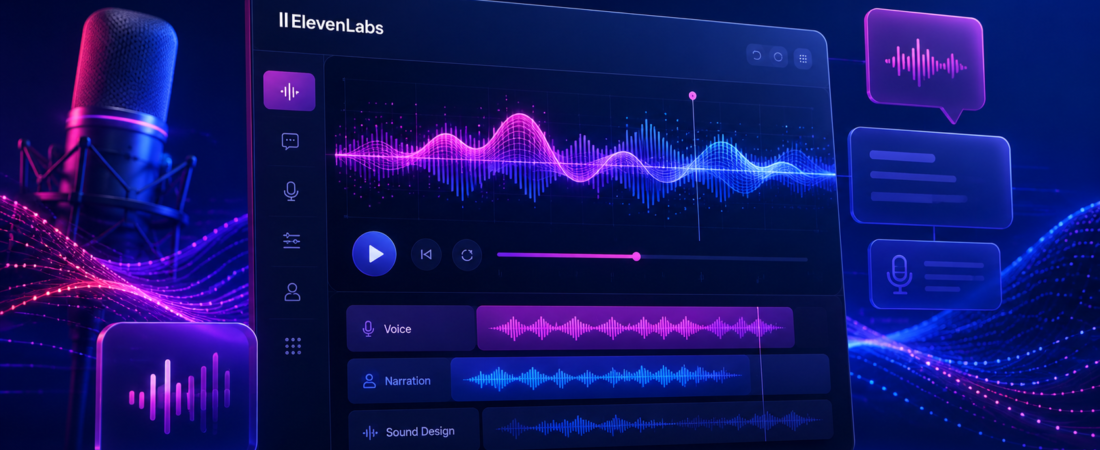
Voiceover Studio is the feature creators should notice
Generating one audio file is easy. Producing a finished narration with multiple speakers, sound effects, and timing is the harder part. Voiceover Studio gives the work a timeline, which is much closer to how an editor thinks. It reduces the awkward download-regenerate-reimport loop, although I still prefer a dedicated video editor for final picture timing.
If your project starts with your own recorded voice rather than a script, do not force ElevenLabs into the center. Descript Studio Sound is designed to rescue speech recordings, while Riverside is the stronger starting point when remote recording quality matters. ElevenLabs is best when you need to create or transform a voice, not merely clean one.
The catch: every correction has a cost
Credit systems look precise until creative work begins. A 1,000-word script may be only six or seven minutes of finished narration, but the first generation is rarely the final generation. You may redo the opening, change a difficult name, test a calmer delivery, or generate three versions of the call to action. The practical cost is therefore the finished script plus the discarded takes.
I budget roughly 1.5 generations for a routine script and closer to 2 generations when names, quotations, or emotional delivery matter.
That is not an official conversion formula; it is a safer planning habit. If your monthly content calendar contains four 1,500-word videos, count the rewrites and pickups before deciding that the smallest plan is enough. This is the same reason I look beyond headline price in our Descript pricing breakdown: media hours and AI credits determine the real ceiling.
Pronunciation is good, not magical
Brand names, acronyms, unusual surnames, and mixed-language scripts still deserve a listening pass. I split difficult lines, rewrite numbers the way they should be spoken, and keep a pronunciation version of the script. A generated voice is not a reason to skip audio direction; it simply moves direction from the recording booth into text and settings.
Long paragraphs can also flatten. Shorter blocks give you cleaner retakes and make it easier to adjust delivery without regenerating a full section. This is one of those unglamorous workflow choices that saves more credits than obsessing over a slightly cheaper plan.
Where it earns its price
- Long-form narration that must remain pleasant
- Recurring branded voiceovers
- Multilingual dubbing with consistent delivery
- Client work where “good enough” audio is not enough
Where I would skip it
- One throwaway social clip a month
- Projects that already have a strong human recording
- Heavy experimentation on a tiny credit budget
- Content where visible authenticity is the main selling point
ElevenLabs pricing in 2026
As checked on August 19, 2026, ElevenLabs lists Free at $0 with 10,000 credits; Starter at $6 with 30,000 credits; Creator at $22 with 121,000 credits (with a discounted first month shown); Pro at $99 with 600,000 credits; Scale at $299 with 1.8 million credits; and Business at $990 with 6 million credits. Enterprise is custom.
| Plan | Monthly price | Included credits | My take |
|---|---|---|---|
| Free | $0 | 10,000 | Best for a genuine sound check |
| Starter | $6 | 30,000 | Low-risk entry for light creator use |
| Creator | $22 | 121,000 | My practical pick for regular narration |
| Pro | $99 | 600,000 | For serious production volume |
| Scale / Business | $299 / $990 | 1.8M / 6M | Team and high-volume territory |
Important: credits are shared across ElevenLabs products, and the amount consumed varies by model and feature. ElevenLabs says unused credits can roll over up to twice the monthly quota while you remain on the same subscription. Check the live estimator inside the product before committing a production calendar.
Which plan would I choose?
Free is enough to answer the only question that matters at first: do you like the voices on your own script? I would not judge it from the polished demo. Paste in difficult, ordinary copy and listen on headphones.
Starter makes sense for a small number of short voiceovers and, importantly, moves you into a paid plan with commercial use rights. Creator is where the allowance starts feeling workable for a consistent YouTube or course workflow. I would not jump to Pro until previous months show that regeneration—not curiosity—is regularly pushing you into the limit.
If your real goal is to generate clips rather than narration, spend the budget elsewhere. Our beginner AI clip generator comparison explains that category, and the OpusClip free-plan guide shows how far you can test without paying.
Can you use ElevenLabs commercially?
According to ElevenLabs’ commercial-use guidance, paid plans include a commercial license subject to its terms and your rights to the input. Content generated during a paid subscription remains commercially licensed after cancellation. Free-plan output is treated differently and requires attribution under the stated terms.
This is a bigger distinction than it appears. A free tool can be technically capable while still being the wrong foundation for monetized client work. I would keep proof of the plan, generation date, and voice permissions with each commercial project. And I would never clone another person’s voice without clear authorization. “The software allowed it” is not the same thing as having the right to do it.
My practical ElevenLabs workflow
- Lock the script first. I remove repeated ideas before audio generation. If the script is still moving, I use a rough system voice.
- Audition with the difficult paragraph. Proper nouns and emotional changes reveal more than a generic opening.
- Generate in sections. Short blocks make pickups cheaper and easier to place.
- Listen away from the screen. If the voice holds attention without visuals, it will usually work in the edit.
- Build the video around approved audio. I bring final narration into Descript or another editor, then create short-form derivatives after the long video is stable.
For that final repurposing step, I use the approach in our guide to turn a YouTube video into Shorts. When the goal is a full content package instead of clips alone, the one-video-to-ten-posts workflow is a better model.
ElevenLabs alternatives I would consider
I would stay with a real human recording when trust and personality are central—founder videos, personal essays, interviews, and sensitive education. If the recording is imperfect, clean it before replacing it. Our Descript podcast editing guide shows a transcript-first path that keeps the speaker’s real performance.
For remote guests, Riverside solves the capture problem first; see what Riverside’s free plan includes. For written repurposing after a recording, Castmagic is more relevant than a voice generator. The “alternative” depends on whether you actually need generated speech, better source audio, or more content from the audio you already have.
Final verdict: is ElevenLabs worth it?
Yes—for creators who publish narration often enough to notice the difference between acceptable speech and convincing delivery. ElevenLabs is not the cheapest way to make sound, but it is one of the easiest ways I have found to make generated speech stop feeling like the weak link in a video.
I would not treat it as a replacement for performance, editing, or judgment. The winning workflow is still script, direction, listening, correction, and final mix. ElevenLabs removes the microphone and talent-booking bottleneck; it does not remove the need for taste.
My recommendation
Test Free with 300–500 words from a real project. If one voice survives a full minute without calling attention to itself, move to Starter for light commercial work or Creator for a regular channel. Upgrade because approved output needs more capacity—not because the voice library is fun to browse.
Pricing, credit allowances, and licensing details were checked against official ElevenLabs pages on August 19, 2026. Plans and product limits can change.